Technology is Robbing Authors of Our Immortality
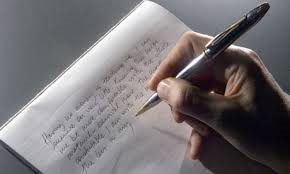 Pick up a pencil. Right NOW pick up a pencil. Or if you prefer a pen, if you can find one, and write you name. In script. If you remember how.
Now, look at your signature. The name you wrote is probably shared by millions, but the way you wrote it is unique and special and no one else in the entire world can write your name the way that you do. It’s yours alone.
Now, on your keyboard, or your laptop, or whatever device you’re reading this right now, type your name. Use whatever font, size or color you want, it won’t matter because all those millions who shares your name can do the exact same thing in the exact same way. Electronically typed, your name is indistinguishable millions of others and what makes that name truly your own is gone.
Your signature contains a small piece of your personality, a tiny microscopic atom of your very soul that flows from your brain down your arm, to your hand and fingers, through the instrument that writes the word onto a piece of paper. For an author, their signature scrawled on the face page of your book is forever inscribed on the first page of our book.
Artists sign their paintings; chisel their name in sculptures made of marble, or glass, or bronze. Their unique signature tells the world that their creation is theirs and theirs alone. For as long as that piece of art exists the artist’s signature, and in a way the artist themselves, lives on for eternity.
But you can’t sign an ebook.
There was a time, not that long ago, that bookstores would hold book signing events for authors. There would be lines of fans waiting for a chance to see the creator of the worlds that existed within the covers of the books they carried with them for the author to sign. Each signature, a unique, individual part of that authors personality that each fan took with them when that brief moment in the presence of the author had passed. That signature would last many years, sometimes long after the author had also passed on.
But those days are long gone. Bookstores are vanishing, and book signings are vanishing with them. The birth of the ebook was the death of personally signed books.
With every new technological advancement, we are moving further and further away from personal contact. We don’t hear other’s voices, we read text messages. We don’t interact at social functions, we “go to meetings” on webinars, or video conference. We are so desperate for physical contact there is now a new cottage industry of paid “huggers” those who will cuddle with you for a price.
Our new “social media” is anything BUT, and we’re all jumping on the anti-social bandwagon.
Why write a letter when an email will do? Why take the time to shop for that perfect card , sign your name and hand write the address when it is so much quicker and easier to send an ecard? Why buy a book when you can read electronic texts, one that looks exactly like the other, lacking any personality or uniqueness. We are becoming homogenized clones, losing our individuality and uniqueness to the technological cyber world.
Text all looks exactly the same no matter who the writer. One book looks exactly the same as another. Words on a computer screen, ipad or cellphone are cold disconnected and distant. There was a reason we used to cuddle up with a good book, now we pay to cuddle up with a perfect stranger.
As authors, we must strive to keep that very special part of ourselves alive. On one hand, we want to sell as many books as we can, whether they are hard copies or ebooks. I recently sold several copies of Undercover Reunion to one of the organizers of Arundel – 17, an annual Man from U.N.C.L.E. convention which takes place in Sussex, England. Although I was unable to attend the event in person, I printed labels with the organization’s logo, signed each one and mailed it to her to put on the front page of the books.
I sent a few extras in the event that other attendees wanted to purchase the “signed” book. Each label was personally signed by me. Knowing my signature, a tiny part of me, would be traveling across the ocean to attend a convention, I was very careful to make each letter look a bit like the author who could not attend in person. It felt wonderful!
Now, pick up that pen write your name. Then look at your signature. That very unique individual signature that represents you and only you and write it again. Now, imagine you’re sitting at a table, a stack of your best- selling novel on your left and a huge line of fans in front of you waiting for you to give them that unique part of you that only you can give. Your signature. Your first edition will be passed on to their children and grandchildren and even if it ends up at a garage sale or a used bookstore, it will always have a part of you that flowed from your hand through the pen onto that page.
That is immortality.
And it is what we have all lost because you can’t sign an ebook.
Now, I need a hug.
Get OUT of the Publishing Traffic Jam
 In the early days of publishing the road to riches was a small highway littered with rejected manuscripts and abandoned dreams. Few who started out on the journey actually made it to the finish line. Many more either crashed and burned, or simply abandoned the trip altogether.
For the financially independent, there was the alternate toll-road. Self-publishing and subsidized publishing (also, unfortunately called “vanity” publishing) was a path less traveled by, but one which many authors hoped would lead to riches, or at least lead to enough wealth to cover the cost of the toll.
Until the latter part of the twentieth century, those were the only two courses for an author to embark on if they wanted to be published. No longer. Computer technology, high speed printers and the Internet has changed the entire highway system. The rocky road of agent to publisher to bookstore to reader has been replaced by the manuscript to hard drive to reader highway of the Cyberspace Transit System. In today’s high tech market, ebooks are downloaded in a fraction of the time it would take to print a book. Print-On-Demand publishers produce a hard print copy in a few days, with no huge stacks of inventory piling up in warehouses, or author’s garages. Seemingly overnight, anyone with a computer and a modem became a “published” author and the “road to riches” has become twenty-four hour traffic jam.
With thousands of authors worldwide driving their new found published work on the same road at the same time, it’s getting harder to see the finish line, let alone reach it. With hundreds of new titles going on-line daily, and hundreds of new authors adding to the massive list on Amazon.com, the problem is no longer getting your book in print. The problem now is getting your book noticed, purchased and read.
Those who have already made it need not worry. Established authors will continue to attract an audience, whether they publish in paper or in cyberspace. The rest of us are only hoping we won’t run out of gas while we’re stuck in traffic. The goal may still be the same, but the length of time it takes to reach that goal just became a whole lot longer. The influx of POD and Ebook publishers has more than doubled since 1999 when Writers Club first announced their new print on demand program. iUniverse entered the scene in October of that same year, followed by Xlibris, 1stBooks, and a number of others. Ebook publishers began paving their own roads early on, and now there are more than fifty, with more than a hundred titles each!
At a meeting of the National Writers Union, Literary Agent Sandra Dykstra commented that iUniverse’s goal to publish 30,000 titles was admirable, but how were they going to find 30,000 readers? Wouldn’t it be better to stay on the well paved road, built by traditional publishing houses that have a more select list and sell 30,000 copies of one title? She had a point. To a point. With so many authors publishing so many titles, how does one avoid the traffic jam on the road to riches? The solution is not to u-turn to the old ways. The solution is to get off at the next exit, find an alternate route, or build your own road!
The old ways worked in the old days, but the 21st Century put an end to the “old” ways and there’s no turning back. While technology has made it easier than ever to publish a book, it has also made it that much harder for newly published authors to break away from the pack and find an audience. The Internet has given authors the golden opportunity to reach an international readership. It’s up to the authors to use this technology to construct their very own road to riches.
Web sites devoted to the promotion of new books are begin created almost daily. The key is in knowing where these sites are and the best way to use them. Any search engine will help you begin the search, but don’t stop there. There are many Egroups listed in Yahoo specifically designed for new authors. These are an excellent source for promotion ideas, plus you can attend any of these ‘round the clock in all kinds of weather without ever having to leave your desk. Members exchange information, support and motivation for each other in cyberspace. Some sites run weekly or monthly live “chats” with a variety of industry guests. DO NOT BE SHY about self-promotion. Lean on that horn long and loud. Post your reviews on all on-line bookstores. If someone gives your book a decent review, copy it and post it everywhere you can. Build your own resource list for your specific genre and promote yourself at least once a day someplace on your list. If you write romance, don’t try to be the “next” Danielle Steele. If you write horror, don’t try to be the “next” Stephen King. Whatever you write, be the very first YOU.
It takes time, hard work and effort, but if you keep your eye one the road ahead and hold tight to that wheel as you speed down your own highway, your own road to riches will leave everyone else far behind eating your dust.
Good luck and good writing!



How Do You Come Up with Ideas for a Novel?
Raven West ♦ March 9, 2014 ♦ Leave a comment
When you introduce yourself as an author, the second question you’ll probably hear most often, after the inevitable “are you self-published?” is “how do you come up with ideas for your novel?”. Setting aside the first question for now, my response is how do I not come up with ideas for my next novel?
For those of us who are cursed with an overactive imagination, stories, characters, plots and themes exist in every second of every minute of each and every day. Take a walk on the beach on a beautiful sunny California day and stop, along with many others, to watch the surfers ride and get wiped out on the waves. While there have been hundreds of stories about the surfing world, what I noticed was the one guy, slightly balding, looked like was maybe 45 or 50 in a solid black wet suit, surf board by his side, doing stretches before joining the younger crowd.
I began to think of story of an aging baby boomer who, in his day, was king of the beach, and now could only gaze at his passing youth riding the waves he could only remember. Perhaps he was still king of the surf, I didn’t see him get into the water. Perhaps he was contemplating hitting the water and showing everyone how it was done. Perhaps, perhaps, perhaps.
Sitting outside a Paris café with my daughter watching a very odd elderly woman as she drank coffee and lit a cigarette talking to herself in French and English and some landguage neither of us understood. I told my daughter that the woman had been a spy for the French during World War II and was captured and tortured by the Nazi’s, so her mind was gone. Or, perhaps her mind was perfectly fine and she was only pretending to be a bit crazy because she was still working as a spy and it was the perfect disguise. Perhaps, perhaps, perhaps.
There are only a small handful of plots; Romance, boy meets girls, boy loses girl, boy finds girls again and they live happily ever after. Of course nowadays it could be boy meets boy, or girl meets girl, but the idea remains the same. Murder mysteries; someone dies, one or several find out who done it, etc. And while the number of core ideas may be recycled over and over ad nauseam, what follows , it the writer has even a smidgeon of imagination, can introduce take readers to characters they want to know and care about and travel to worlds that are, literally, beyond their wildest imagination.
Every story begins with one question; what if? Where it goes from there, and how that story is told is what makes this work, if one would call it work, the best job there ever is. W
Which just gave me an idea for a story of a writer who….
Share this: